
Our history
1909
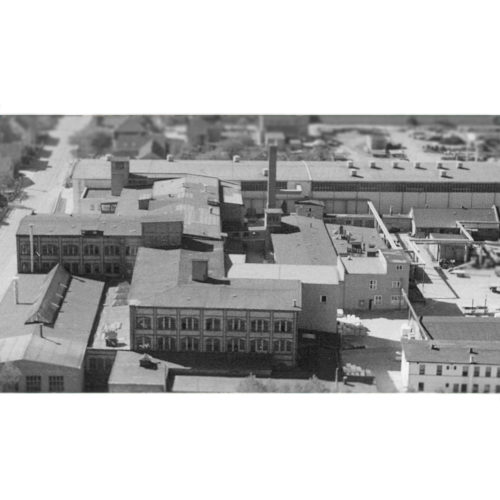
Könitz Porzellan was founded in 1909 with four round kilns. Its first products – cups, mugs, bowls and tea strainers – were shipped mainly to England.
1912
Even 1912 the company had to expand because of the rising demand and became known as the Koenitz Porcelain Factory Gebrüder Metzel.
Over the following decades, the company entered new domestic and international markets and became one of the region’s established medium-sized manufacturers.
1948
In 1948, the company was taken over by the Soviet joint-stock company Keramische Werke Hermsdorf and production was switched to technical porcelain. In 1951, after reparation payments ended, KÖNITZ became state-owned while remaining part of the Hermsdorf operation. From 1954, the factory once again produced household porcelain under its own management.

1962
In 1962, the KÖNITZ porcelain factory and the Kahla porcelain factory merged to form the “United Porcelain Factories Könitz-Kahla”. Products from this period carried a shared backstamp.
At the beginning of the 1970s, the KÖNITZ name disappeared from the backstamp as further porcelain factories, including Volkstedt, Uhlstädt and Garsitz near Königsee, were incorporated into the Kahla combine.
1984
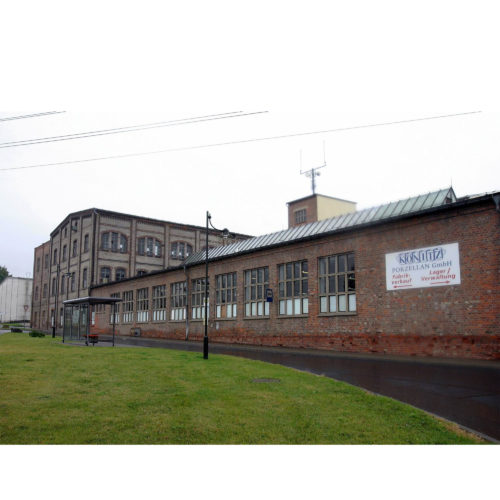
Between 1984 and 1985, investment in Könitz created one of the most modern mug production lines of its time. The new line went into operation in December 1985.
KÖNITZ was one of the few porcelain factories alongside Kahla to continue operating after the political changes of 1989.
Under Treuhand management, the company developed its own product range, including coffee mugs, children’s sets, seasonal products for Easter and Christmas and customised items. KÖNITZ also returned to international markets, exporting to countries including the Netherlands, Israel, Italy, Norway, Austria and the United States.
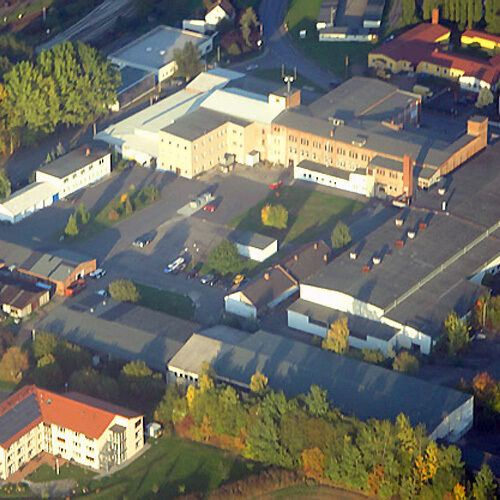
1993 – KÖNITZ Porzellan is taken over by Turpin Rosenthal
After working in the porcelain industry at Rosenthal AG, in furniture retail at IKEA of Sweden and for seven years in the United States, Turpin Rosenthal returned to Germany after reunification. In the early 1990s, his experience and entrepreneurial outlook led him to look for a new business opportunity. “I had actually promised myself that I would not work in the porcelain industry,” he recalls. Porcelain is a craft-intensive industry, and low-cost producers from Eastern Europe and other countries appeared to have strong cost advantages at the time. “Because of the Rosenthal name, however, I was repeatedly offered porcelain companies that were on the market,” he says.
In autumn 1993, attention turned to Könitz Porzellan GmbH. The factory was attractive because it had been a highly automated mug-production site within the former VEB Kahla–Triptis–Ilmenau combine. Production in the GDR had been strongly specialised: Kahla focused mainly on plates and hollow or cast items, while KÖNITZ operated four mug production lines and manufactured the combine’s cups and mugs. The combination of modern automated production and the absence of a dedicated mug specialist in continental Europe in the mid-1990s led Turpin Rosenthal to reconsider the opportunity. He asked whether the basic product – the mug – could be manufactured efficiently enough to remain viable in Germany while being marketed in an entirely new way. This idea became the basis for a business model that combined efficient production in Germany with a marketing approach that was unusual for the porcelain industry at the time.
Based on this concept, Turpin Rosenthal negotiated with the Treuhand to purchase the company. Together with the managing director at the time, he developed a new business strategy. Early media coverage, including an appearance with television presenter Thomas Gottschalk, helped raise the company’s profile.
The first major setback came from the legal framework of the privatisation process. Former owners who wished to reclaim their companies were given priority. The heirs of the Metzel family, who had founded the company, had initially shown no interest in taking it over.
When Turpin Rosenthal’s plans became public, however, the former owners changed their position and requested the return of the company. At the same time, buyers could receive temporary loss compensation from the Treuhand to cover the start-up period while investments and restructuring were carried out. Because the former owners asserted their claims, the transfer to Turpin Rosenthal was delayed for a long period. At times it appeared that the founding family would take over production together with a porcelain company from Upper Franconia, which would have ended the new business plan before it had fully begun.
1994
A first crisis
In 1994, the Treuhand was succeeded by the BVS. The new organisation had a different mandate: rather than supporting companies, its focus was on completing existing privatisation contracts. For Könitz Porzellan, this meant that extending the existing support period was no longer an option.
One obstacle followed another. The BVS first had to negotiate with the former owners, delaying privatisation and the planned investment. Funding that had originally been intended to support the restructuring was increasingly absorbed by ongoing losses, leaving little scope for the investment programme. Meanwhile, the Metzel family, works council representatives and the competing porcelain company formed an alliance and presented an alternative plan for the workforce.
Unlike Turpin Rosenthal’s restructuring plan, the alternative proposal promised to preserve all jobs and increase wages. The situation became increasingly difficult: the BVS would not provide further subsidies, while employees and trade unions protested against the proposed new ownership. The IG Chemie-Papier-Keramik trade union organised major demonstrations at the factory. On one occasion, the workforce blocked federal highway B281 to draw attention to the dispute. At the end of 1994, the Metzel family withdrew from plans to participate in Könitz Porzellan. The reason was financial: the support period had expired and substantial private capital would have been required for liquidity and investment. The prolonged dispute over privatisation had consumed valuable time and brought the company close to insolvency. After a delay of around 18 months, Turpin Rosenthal no longer had access to sufficient funding for the originally planned major investment.

1996
Was that the end?
No. A different route was found. Turpin Rosenthal and Reinhard Krauße, then warehouse manager and later production manager, had to sell much of the company’s equipment to stabilise the business.
Kilns, tractors and other plant and equipment were sold to finance the redundancy payments associated with the workforce reduction. After six months of restructuring, a company that had employed more than 300 people before the fall of the Berlin Wall was reduced to just eight employees.
Production was shut down temporarily; the remaining business focused on selling stock and managing the former facilities.
The crisis led to a new business model. Mug production lines and moulds were transferred to nearby porcelain manufacturers, initially in the Czech Republic, which produced blanks exclusively for Könitz Porzellan.
Without its own whiteware production, Könitz Porzellan concentrated on selected market segments that required dedicated product development and sales approaches. One focus was retail: department stores, gift shops and specialist porcelain retailers sold KÖNITZ mugs as individual gift items. Retailers were initially sceptical about selling mugs without matching tableware, but consumers responded differently. The mug became successful as a stand-alone gift, particularly when its design told a story and gave the product an identity of its own.
Successful collections from this period included “Kamasutra” and an exclusive Andy Warhol collection based on a licensing agreement. Another important market developed around mugs as promotional and merchandising products, allowing companies to create branded items for advertising, public relations and merchandise. KÖNITZ positioned itself as a partner for customers with demanding design and quality requirements.
Custom-printed mugs already existed, but the market was often dominated by simple logo applications. As a porcelain manufacturer, Könitz Porzellan focused on higher-quality materials and durable ceramic decoration with strong colour reproduction.
Early customers for customised products included Porsche, Melitta, Postbank, the Louvre in Paris and MoMA in New York. The company grew again quickly: from eight employees during the crisis period to around 50 in 1996 and 80 in 1998. That year, Könitz Porzellan also acquired Wiedemannsche Druckerei AG, one of Thuringia’s oldest companies.
1998
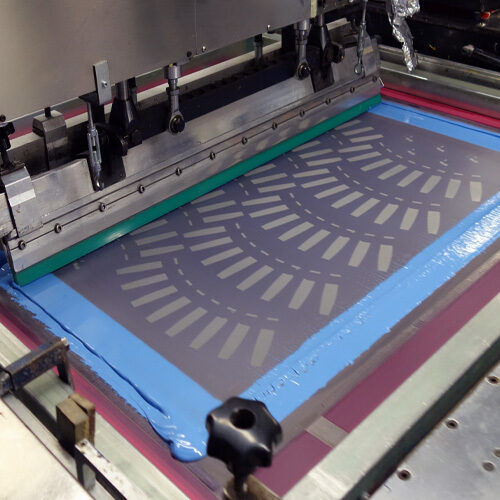
Wiedemannsche Druckerei AG has a long history of its own. Founded in 1673 as a court book printer, it specialised from 1880 in ceramic colour printing and fired-on decals. Over time, the company became an important supplier of sophisticated decoration for the porcelain industry.
As the German porcelain industry contracted and manufacturers such as Kahla Porzellan and Graf Henneberg became insolvent, the market for ceramic printing declined sharply and the printing company faced closure.
Könitz Porzellan had already recognised that high-quality decoration was a key technical capability. Precise printing, sophisticated colours and unusual effects transformed a simple porcelain blank into a distinctive finished product.
The acquisition kept Wiedemannsche Druckerei in operation and secured an important supplier for KÖNITZ. Closer cooperation in product development, sales and, above all, decoration strengthened the group’s ability to develop distinctive products and grow in its target markets. Over the following years, the business expanded, created new jobs and acquired additional companies. International subsidiaries were established in the United States, Australia and Thailand, while KÖNITZ products became available through retailers in cities including New York, Tokyo, Singapore, Paris and Berlin.
From its roots in Thuringia, KÖNITZ has developed into an internationally active specialist in mugs and cups.
2018
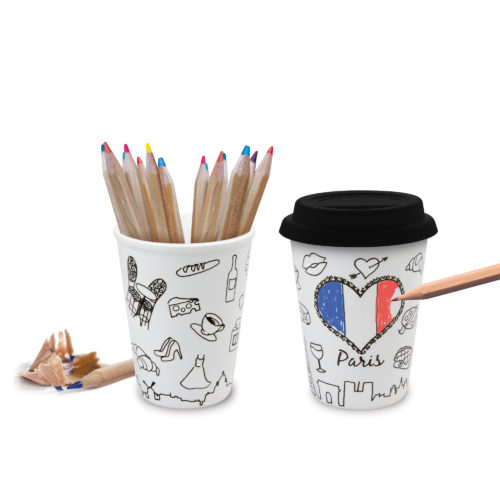
In 2018, KÖNITZ received the Promotional Gift Award for the “Selfmade Mug”, a porcelain mug with a special surface that can be drawn on with pencils and wiped clean again. The product highlighted KÖNITZ’s ongoing development work for both retail and custom design.
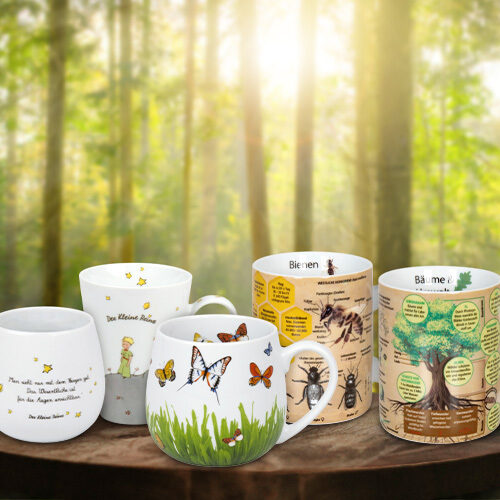
Even 2009 KOENITZ present the lasting "To Go mug" made of porcelain. Also licensed motifs from "Guess how much I love you" (launch 2007) over "The little Prince" (launch 2011) to "Asterix&Obelix" (launch 2015) enrich the mug portfolio and became to bestsellers.
One of the successful new products of 2017 was “Coffee for One”, developed around the renewed popularity of hand-filtered coffee.
111 years
KÖNITZ porcelain in the region
KÖNITZ remains closely connected to its home region while selling mugs around the world. At the factory outlet in KÖNITZ, visitors can discover products from the brand range as well as selected custom-made pieces and outlet items. Selected seconds and outlet products are offered at reduced prices, making the factory shop a popular destination in the region.
2022
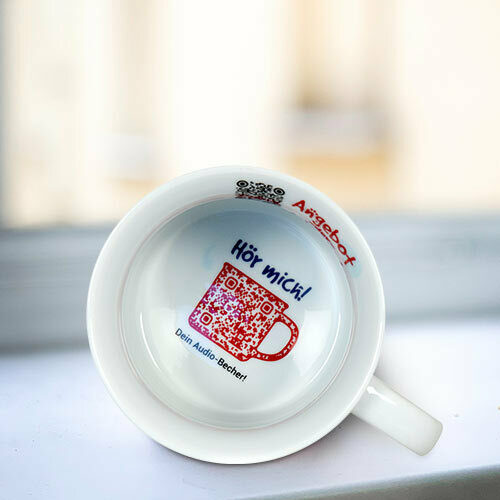
QR-Mug-Digital
KÖNITZ Porzellan developed the QR-Mug-Digital, combining a porcelain mug with a scannable digital interface. The patented concept connects traditional ceramic decoration with digital communication.
2022
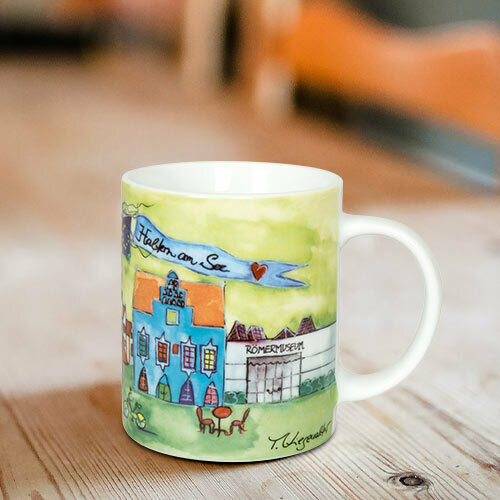
KÖNITZ Porcelain produces the first cups using the digital printing process
A streamlined pre-press process enabled Könitz Porzellan to produce durable photo and multicolour decoration directly for porcelain using a defined colour space. Compared with sublimation, the ceramic digital printing process offers a fired-on, long-lasting option for multicolour and photographic designs.

2023
350 years Wiedemannsche Druckerei
Wiedemannsche Druckerei AG produces decals for glass, ceramics and porcelain as well as special surface effects such as wood, steel, oil-painting textures and relief structures. Founded in 1673, the company has a long printing tradition in Thuringia and Saxony and specialises in complex multicolour ceramic decoration. Traditional hand lithography remains part of its expertise. Combined with modern digital image processing and pre-press technology, this expertise enables a broad range of services from concept development to exclusive ceramic decoration.


